
Lot 619
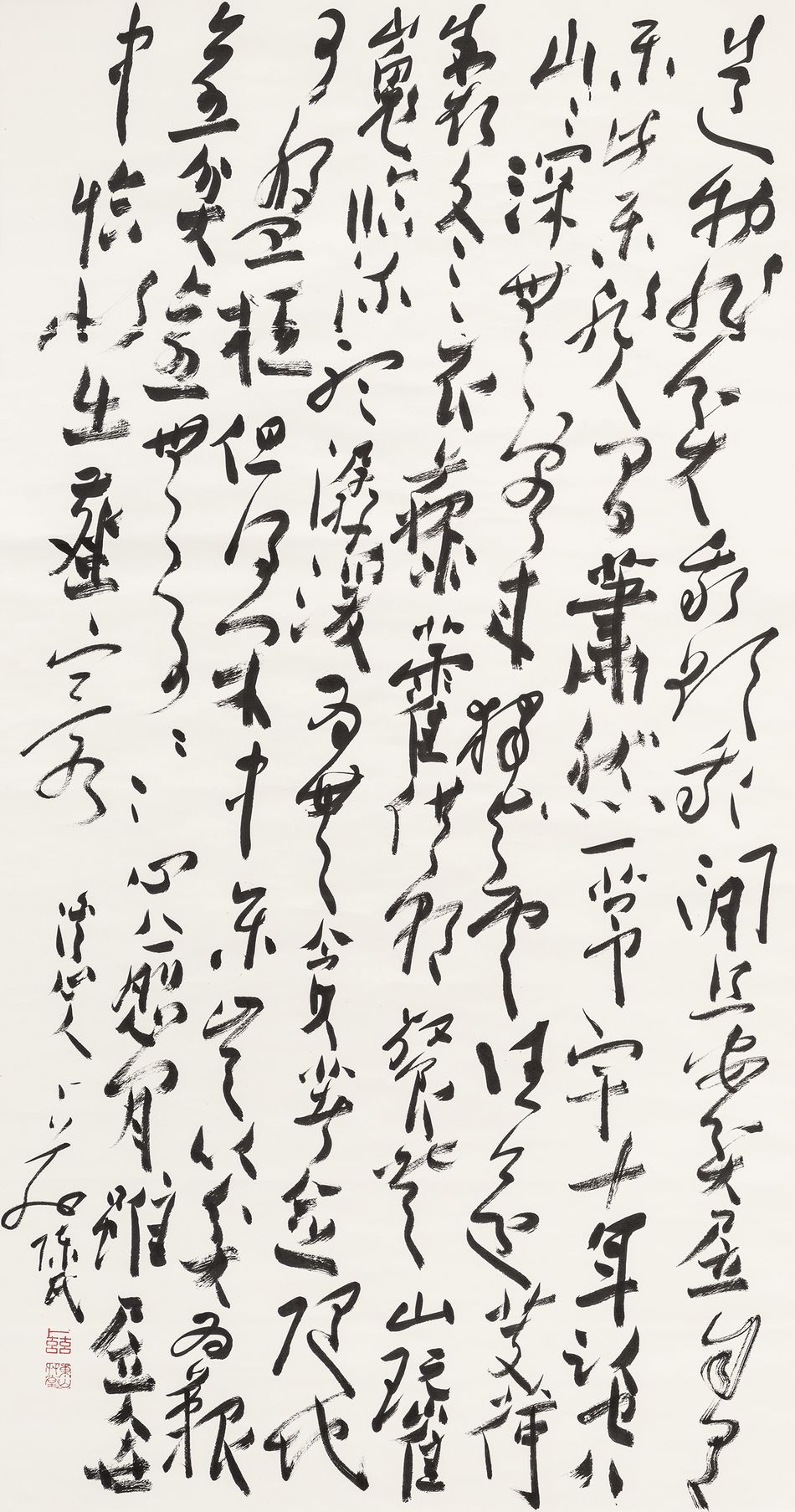
Calligraphy in Cursive Script
PU TZU (Bu Zi) (Taiwanese, 1959 - 2013)
Ink on paper, scroll
180 x 95 cm
Estimate
TWD 80,000-160,000
HKD 20,000-39,000
USD 2,500-5,000
CNY 17,000-35,000
Sold Price
TWD 132,000
HKD 32,754
USD 4,184
CNY 28,448
Signature
With two seals of the artist
EXHIBITED
"2006 Cross-Strait Artists Group Exhibition", Tainan County Government, Tainan, 14 October, 2006 - 19 November, 2006
"The Cold Flowers Grew in Old Cliffs: Buzi Art Collection Exhibition", The National Sun Yat-sen Memorial Hall, Taipei, 29 December, 2022 - 11 January, 2023
ILLUSTRATED 2006 Cross-Strait Artists Group Exhibition Album, Tainan County Government, Tainan, 2006, p. 29 The Cold Flowers Grew in Old Cliffs: Buzi Art Collection Exhibition, Ease Art, New Taipei City, 2022, pp. 192-193
+ OVERVIEW
The development of the central hanging scroll can be traced back to the transition between the Ming and Qing dynasties. Advances in brick-wall construction enabled buildings to reach greater heights, which in turn generated a demand for artworks of larger scale. At the same time, paper of greater dimensions became available. As both architectural spaces and writing surfaces expanded, the central hanging scroll rose to prominence. This format was well suited for inscribing longer aphorisms or literary texts, and it was often displayed together with couplets, becoming an important medium through which the literati and gentry expressed family values and scholarly cultivation. Writing a central scroll presents considerable challenges. The calligrapher must maintain concentration for extended periods while standing; once the flow of breath is interrupted, the work easily appears slack and lacks continuous energy. Moreover, the enlarged scale magnifies every detail of brushwork—any imbalance in lifting, pressing, or turning of the brush can readily result in superficiality or excessive mannerism.
In this work, the lines appear resilient and sinewy, with a continuous and rapid movement of the brush. The contrasts between lifting and pressing are clearly articulated, while the turns and transitions reveal adherence to established principles. This demonstrates that PU Tzu did not pursue emotional outburst for its own sake; rather, he infused lyrical expression into a rational structural framework. In tracing the lineage of classical calligraphy, PU Tzu drew extensively from the works of late-Ming calligraphers such as Fu Shan, whose large central scrolls provided significant inspiration. The subject of this work is “Creation Does Not Leave Me Impoverished” is transcribed from a poem on humble dwelling by Zen Master Dōgen, the founder of the Japanese Sōtō Zen school. The poem describes the serene detachment of a recluse from worldly splendor, a theme that resonates with PU Tzu’s own later life, when he returned to his hometown of Tainan and created works in his studio at the Old Mango Tree House. The rhythm of the brushwork rises and falls, alternating between swift and measured movements, as if following the shifting states of the calligrapher’s mind. The written characters thus become not merely carriers of meaning, but also a transformation and condensation of PU Tzu’s personal life experience.
This work was exhibited in the “2006 Cross-Strait Artists Group Exhibition.” In addition to PU Tzu, the Taiwanese artists represented in the exhibition included Tsai Yun-cheng, Chiang Ch’ing-jung, Chou Cheng, and Chang Ku-nien, collectively reflecting the important state of Taiwanese painting and calligraphy at the time. Earlier, in 2005, PU Tzu had been invited to participate in the First International Cursive Script Art Exhibition held in Hangzhou. Later, in 2012, he became the first Taiwanese calligrapher to be exhibited at the Suzhou Museum. PU Tzu passed away in 2013; by that time, his work had already gained recognition on an increasingly international stage.
Refined Brushwork:Ink Paintings & Works of Art
Ravenel Spring Auction 2026 Taipei
Sunday, May 24, 2026, 4:00pm