
Lot 050
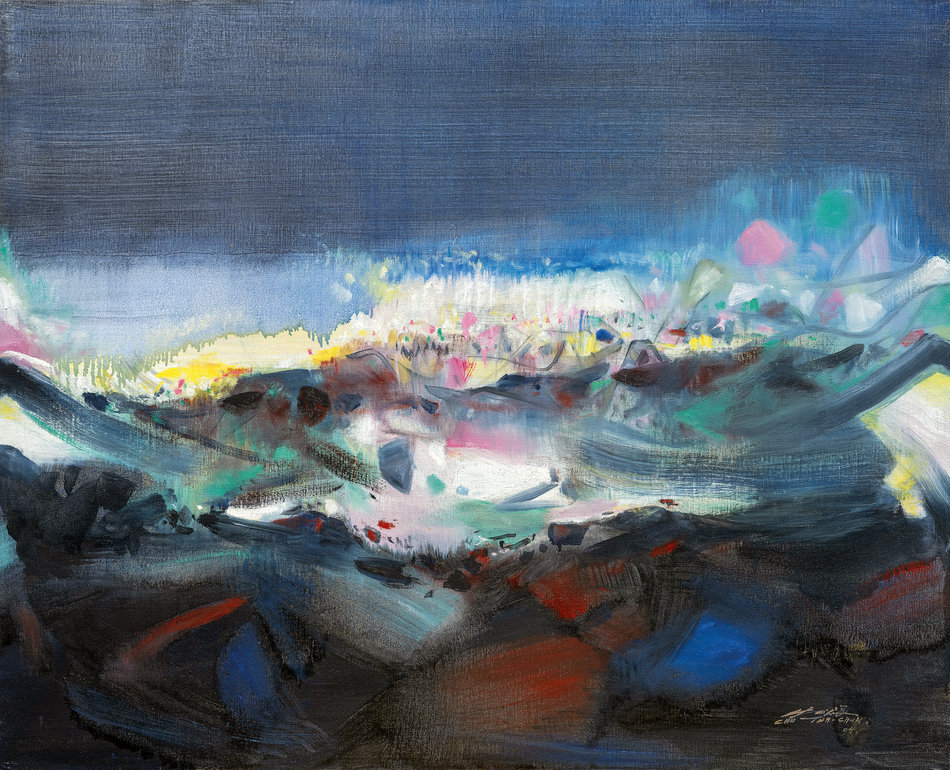
Mirroir de l'illusion
CHU Teh-chun (Chinese-French, 1920 - 2014)
2004
Oil on canvas
81 x 100 cm
Estimate
TWD 6,500,000-8,500,000
HKD 1,605,000-2,099,000
USD 205,000-268,100
CNY 1,368,000-1,789,000
Sold Price
Signature
Signed lower right CHU TEH-CHUN in Chinese and English, dated 04
Signed reverse CHU TEH-CHUN in English and Chinese, dated 2004 and titled MIRROIR DE L’ILLUSION
PROVENANCE
Ravenel, Taipei, December 6, 2009, lot 051
Acquired from the above by the present owner
ILLUSTRATED
Pierre-Jean Rémy, Chu Teh-Chun , Éditions de la Différence, Paris, 2006, color illustrated, p. 268
+ OVERVIEW
Chu Teh-Chun (1920–2014) was one of the mostsignificant Chinese artists of the twentieth century,internationally recognised for his distinctive synthesis of traditional Chinese artistic sensibilities and Westernmodernist painting. Created in 2004, Miroir de l’illusion demonstrates the artist’s mature mastery of colour, gestural brushwork and spatial composition,while inviting contemplation of Eastern philosophical ideas concerning appearance and essence, emptiness and substance, and the interconnectedness of all things. Viewed through the Buddhist concept of “infinite interpenetration and unobstructed
interconnectedness”, the painting evokes a spiritual realm in which images endlessly reflect and merge into one another. In this way, abstraction transcends purely visual form, becoming a vehicle for philosophical reflection on the order of the universe and the nature of human perception. Chu Teh-Chun studied at the National College of Art in Hangzhou, where he received a rigorous education in both traditional Chinese painting and Western art.
After moving to Paris in 1955, he gradually embraced abstraction, integrating the rhythmic movement of Chinese calligraphy and the interplay of presence and absence in traditional landscape painting with theluminous qualities of Western oil painting. From the development of his abstract language in the 1950s and 1960s, through his increasingly sophisticated exploration of colour and spatial depth from the 1970s to the 1990s, to the assured expressiveness
of his work in the 2000s, Chu consistently sought to transform visible natural phenomena into expressions of inner experience. Created during this mature
period, Miroir de l’illusion embodies the artistic language distilled from decades of exploration. Chu’s painting lends itself naturally to such philosophical associations. Through calligraphic gestures, he creates a fluid visual rhythm, while overlapping colours, shifting tonal contrasts and the interplay between solid forms and open space establish relationships in which shapes and hues
resonate with one another rather than remain isolated. The most compelling aspect of Miroir de l’illusion lies in its capacity to transform looking into an everunfolding spiritual journey. A mirror reflects all things without possessing them; an illusion, though seemingly unreal, acquires meaning through the act of perception. Together, these ideas lend the painting’s title a philosophical resonance that extends beyond appearances. Viewed through the lens of
Huayan Buddhism, the images reflected in a mirror may evoke the notion of “infinite interpenetration”: all things reflect and depend upon one another, with
each phenomenon containing the traces of countlessothers in an endless web of relationships. The related concept of “unobstructed interpenetration of all things” suggests that although phenomena retain their individual haracteristics, none exists in isolation each participates in a greater, interconnected whole. Viewers may discern associations with glaciers, drifting
mist or luminous skies, yet no single image can fully define the composition. Each encounter may reveal
new meanings through the interplay of colour and imagination. The painting thus becomes more than a depiction of a particular landscape; it presents a visual
experience in which myriad forms interact, influence one another and continually come into being. This openness of interpretation lends the work its enduring
contemplative depth.
In terms of its documentary significance, Miroir de l’illusion was included in a monograph on Chu Teh- Chun compiled by Pierre-Jean Rémy and published
in Paris by Éditions de la Différence in 2006. Rémy, like Chu, was a member of L’Académie française, and was also a distinguished French scholar, novelist and
diplomat. This publication history provides a valuable documentary reference for further research and contributes to the work’s significance as a collectible.
Combining a distinctive artistic language with the broader cultural significance of East–West artistic exchange, Chu’s mature paintings offer collectors a compelling opportunity to engage with an important chapter in the history of modern Chinese abstraction.
Related Info
Modern & Contemporary Art
Ravenel Autumn Auction 2026 Taipei
Sunday, December 6, 2026, 1:30pm