Lot  614 Ravenel Spring Auction 2026 Taipei

Ravenel Spring Auction 2026 Taipei

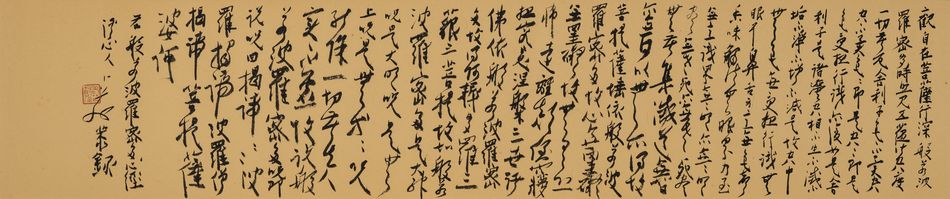
Heart Sutra in Running Script

PU TZU (Bu Zi) (Taiwanese, 1959 - 2013)

Ink on paper, framed

23 x 111 cm

Estimate

TWD 60,000-120,000

HKD 15,000-29,000

USD 1,900-3,800

CNY 13,000-26,000

Sold Price


Signature

Signed PU Tzu in Chinese
With one seal of the artist

PROVENANCE
Private collection, Taiwan

+ OVERVIEW

Buddhism was introduced to China during the Eastern Han dynasty. Before the widespread use of printing, the translation and transmission of Buddhist scriptures relied primarily on manual copying. Writing thus became an essential means of religious dissemination. In the early period, to ensure the accurate transmission of scriptures within monastic communities and among believers, regular script was generally adopted as the standard form of writing. As Buddhism flourished and the number of scriptures rapidly increased, the need for writing in the contexts of lectures, commentaries, and daily religious practice also expanded. Consequently, semi-cursive and cursive script gradually came into wider use for copying texts and taking notes.

By the mid-to-late Tang dynasty, with the rise of Chan (Zen) Buddhism, writing was no longer merely a tool for transmitting texts but also became closely connected with spiritual cultivation. Within Chan thought, particularly the concept of “no-mind”, the movement of the brush in calligraphy was understood as a natural manifestation of the flow of breath and the state of mind. In this context, cursive script—with its highly dynamic and spontaneous qualities—proved especially suited to expressing the focused yet unimpeded state sought in Chan practice, thereby becoming a form of writing that combined both practical and spiritual functions.

For PU Tzu, writing religious scriptures formed part of his daily practice. Through the repeated transcription of Buddhist texts, he cultivated concentration and inner stability. The meditative discipline accumulated through this practice enabled his cursive script to remain controlled even in moments of expressive freedom, preventing it from dissolving into disorder. A close examination of the work reveals lines that are elegant yet vigorous, refined yet edged with strength, demonstrating PU Tzu’s confident command of movement and force in his calligraphy. Moreover, as a devoted Buddhist, PU Tzu maintained a considerable degree of legibility in this semi-cursive work, allowing the scripture to remain readable while preserving the expressive vitality of cursive script—an indication of the reverence and sincerity underlying the act of copying the sacred text.
Related Info

Refined Brushwork:Ink Paintings & Works of Art

Ravenel Spring Auction 2026 Taipei

Sunday, May 24, 2026, 4:00pm